Easy Crochet Patterns for Beginners: Your Step-by-Step Guide to Getting Hooked
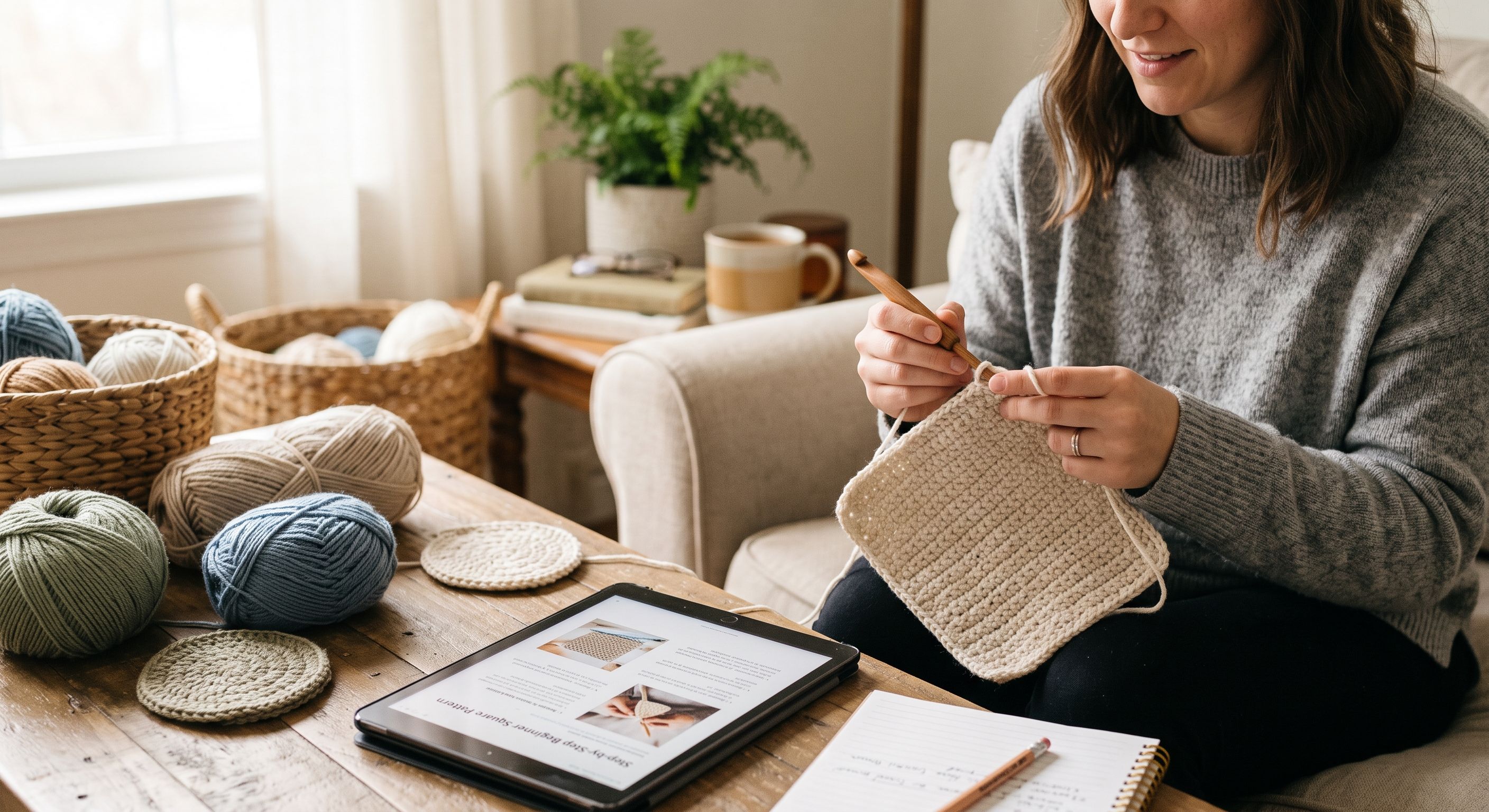
Have you ever scrolled through social media, spotted a beautiful handmade blanket or a cozy scarf, and thought, “I wish I could make that”?
Maybe you even bought a hook and some yarn once. But then you opened a pattern, saw a wall of abbreviations, and promptly shoved everything into a drawer.
We’ve all been there.
Here’s the good news: learning to crochet isn’t nearly as complicated as it looks. With the right easy crochet patterns for beginners and a little patience, you can be making things you’re actually proud of — sometimes within your very first afternoon.
This guide is for absolute beginners. We’ll walk you through everything from choosing your first supplies to finding beginner crochet patterns with step-by-step instructions that actually make sense. No confusing jargon. No assuming you already know things. Just real, practical help from someone who remembers exactly how overwhelming it felt at the start.
Let’s get those hooks ready.
Why Crochet? (And Why Now?)
Crochet isn’t just about making things. It’s about making time for yourself.
There’s something almost magical about taking a single strand of yarn and transforming it into something useful, beautiful, or heartfelt. A scarf for your sister. A blanket for a new baby. A dishcloth that makes doing the dishes just a little more pleasant.
And the mental health benefits? Real.
The repetitive motion of crochet has been shown to reduce stress and anxiety — it’s basically meditation with a hook. Many women find that twenty minutes of crochet at the end of the day helps them unwind better than scrolling through their phones ever could.
Plus, you’re creating something with your own two hands. In a world where so much feels out of our control, that’s incredibly grounding.
What You Actually Need to Get Started
Let’s talk supplies. You don’t need a craft room full of equipment. You don’t need expensive yarn. You need four things:
- •Worsted weight yarn (this is a medium thickness — look for “4” on the label)
- •A 5 mm (H-8) crochet hook
- •A pair of scissors
- •A tapestry needle (for weaving in those loose ends)
That’s it.
If you’re standing in a craft store feeling lost, just grab a ball of cotton or acrylic yarn in a light color (dark yarn makes it harder to see your stitches) and a 5mm hook. The store clerk can point you in the right direction — they get this question all the time.
One tip we wish someone had told us: start with a smooth yarn, not something fuzzy or textured. You need to see what you’re doing when you’re learning. Save the fancy stuff for later.
The Three Stitches That Unlock Everything
Here’s a secret most beginner crochet patterns won’t tell you: almost everything you’ll ever make is built from just a handful of basic stitches.
Master these three, and you can make so many simple crochet projects for beginners.
1. The Chain Stitch (ch)
This is where every project begins. It’s your foundation — literally. You’ll make a slip knot, loop the yarn over your hook, and pull it through. Repeat. That’s it. A chain of stitches is the starting point for almost every crochet pattern you’ll ever follow.
2. Single Crochet (sc)
This is the workhorse stitch of crochet. It’s short, dense, and creates a sturdy fabric. Insert your hook into a stitch, yarn over, pull through, yarn over again, pull through both loops. Practice this until it feels natural — it’s the stitch you’ll use most often as a beginner.
3. Double Crochet (dc)
Slightly taller and more open than single crochet, double crochet works up faster and gives your projects a lovely drape. Yarn over, insert your hook, yarn over and pull through, yarn over and pull through two loops, yarn over and pull through the last two.
Learn these three stitches in order — chain first, then single crochet, then double crochet. Practice each for about ten minutes before moving to the next. By the time you’ve got all three down, you’re ready for beginner crochet projects step by step.
5 Easy Crochet Projects for Absolute Beginners
Now for the fun part. Here are five beginner crochet projects with instructions that won’t make your head spin.
1. The Classic Dishcloth
Why it’s perfect for beginners: It’s small, flat, and uses only single crochet.
What you’ll learn: Chain stitch, single crochet, turning your work, and fastening off.
Chain about 20 stitches. Single crochet in each stitch across. Chain one, turn your work, and single crochet back across. Keep going until your dishcloth is roughly square. That’s it. You just made something useful.
2. A Cozy Scarf
Why it’s perfect for beginners: It’s just a really long rectangle. If you can make a dishcloth, you can make a scarf.
What you’ll learn: The same skills as the dishcloth, plus a little more patience.
Chain until your starting row is as wide as you want your scarf. Then single crochet (or double crochet, if you’re feeling confident) back and forth until it’s as long as you want it. This is one of the most satisfying easy crochet projects to make at home — you’ll actually wear it.
3. Cup Cozy
Why it’s perfect for beginners: It’s tiny (instant gratification!) and works up in under an hour.
What you’ll learn: Working in rows, seaming, and basic shaping.
Make a rectangle that’s roughly the height of your coffee cup and long enough to wrap around it. Single crochet back and forth. When it’s done, sew the short ends together. Slip it over your mug and feel like a genius.
4. Granny Square
Why it’s perfect for beginners: It’s the most famous crochet pattern for a reason.
What you’ll learn: Working in the round, increasing, and color changes.
Start with a magic ring or a small chain circle. Work clusters of double crochet separated by chain spaces. Keep going around and around. One granny square becomes a blanket if you make enough of them.
5. Simple Headband or Ear Warmer
Why it’s perfect for beginners: It’s a wearable you can finish in one evening.
What you’ll learn: Working flat, seaming, and maybe a new stitch like half-double crochet.
Make a rectangle that fits around your head. Single crochet or half-double crochet rows until it’s wide enough. Sew the ends together. Instant cozy accessory.
Reading Crochet Patterns: A Cheat Sheet
Here’s where a lot of beginners get stuck. You find a pattern that says something like:
“Ch 20, sc in 2nd ch from hook and in each ch across, turn.”
And your brain just... freezes.
Here’s how to decode that:
Abbreviation
What It Means
ch
chain stitch
sc
single crochet
dc
double crochet
sl st
slip stitch
st(s)
stitch(es)
yo
yarn over
So “Ch 20, sc in 2nd ch from hook and in each ch across, turn” means:
Make 20 chain stitches.
Skip the first chain (the one closest to your hook).
Single crochet into the second chain from the hook.
Single crochet into every chain after that until you reach the end.
Turn your work around to start the next row.
See? Not so scary when you break it down.
Look for crochet patterns with step-by-step instructions — the good ones will walk you through every single row. Many patterns also include video tutorials now, which can be a lifesaver.
Common Mistakes (And How to Fix Them)
“My project is getting wider/narrower!”
You’re probably missing the last stitch in the row or adding an extra one at the beginning. Count your stitches at the end of every row until you build the habit of catching that last stitch.
“My tension is all over the place.”
This is the most common frustration for beginners. Your first few rows might look uneven. That’s normal. The fix is practice — twenty to forty minutes a day builds muscle memory faster than you’d think. Your hands will figure it out.
“I keep losing count.”
Use stitch markers! A bobby pin, a paperclip, or a proper stitch marker can save you from counting to fifty and forgetting where you were. Mark every ten stitches if you need to.
“I made a mistake three rows back.”
Here’s a piece of advice we wish we’d learned earlier: it’s okay to rip it out and start over. Crochet is forgiving. You’re not wasting time — you’re learning. Every crocheter has frogged (ripped out) countless rows. It’s part of the process.
Where to Find Easy Crochet Patterns for Beginners
You have options:
- •Free patterns online — blogs and YouTube are full of them. Look for patterns labeled “beginner” or “easy.”
- •Ravelry — it’s like Pinterest for crochet and knitting. You can filter by skill level.
- •Printable crochet patterns — many designers sell PDFs you can download and print. No ads, no scrolling, just clear instructions.
- •Books — a good beginner crochet book with clear photos is worth its weight in yarn.
One thing to watch out for: not everything labeled “beginner” actually is beginner-friendly. Look for patterns that explicitly say they use only basic stitches (chain, single crochet, double crochet). Avoid anything that mentions “puff stitch,” “popcorn stitch,” or “Tunisian crochet” until you’ve got more practice.
Ready for More? Your Complete Crochet Roadmap
By now, you’ve got the basics. You know which hook to buy, which stitches to learn first, and what projects to start with.
But here’s the thing — going it alone can still feel overwhelming. There’s a difference between knowing the theory and actually sitting down with your yarn, wondering if you’re doing it right.
That’s exactly why we created [Smyt l'Guide dyalek] .
This isn’t just another collection of patterns. It’s a complete beginner’s roadmap that walks you through everything — from your very first slip knot to finishing your first project with confidence. Crochet patterns with step by step instructions, clear photos, troubleshooting tips, and projects that actually build your skills in the right order.
No guesswork. No frustration. Just a clear path from “I’ve never held a hook” to “I made this myself.”
Think of it as having a friend who already knows how to crochet sitting right next to you.
[Insert link to Smyt l'Guide dyalek here]
Final Thoughts
Learning to crochet is a journey, not a race.
Your first project probably won’t be perfect. Your tension might be weird. You might frog (rip out) more rows than you keep. That’s all part of it. Every single experienced crocheter started exactly where you are right now — holding a hook, staring at yarn, wondering if they could actually do this.
You can.
Start with a dishcloth. Make a scarf. Give yourself permission to make mistakes. And remember: every stitch you make is progress.
Happy crocheting! 🧶
FAQ
1. How long does it take to learn crochet as a beginner?
Most people can learn the basic stitches — chain, single crochet, and double crochet — in a single afternoon. The key is practice. Spend 20 to 40 minutes a day for the first week, and you’ll be amazed at how quickly your hands learn the movements. Your first project (like a dishcloth) can be finished in a few hours. A scarf might take a few evenings. The speed comes with practice.
2. What’s the easiest thing to crochet for a complete beginner?
A dishcloth or washcloth is widely considered the easiest beginner project. It’s small, flat, uses only one stitch (single crochet), and doesn’t require shaping or seaming. Plus, even if it looks a little uneven, it still works as a dishcloth! A simple scarf is the next step up — it’s the same concept, just longer.
3. Where can I find free beginner crochet patterns with step-by-step instructions?
YouTube is an incredible resource — many creators show every single stitch on camera. Blogs and pattern websites like Ravelry also offer thousands of free patterns you can filter by skill level. Look for patterns that include photos or video tutorials alongside the written instructions. And if you want everything in one organized place with clear guidance from start to finish, that’s exactly what [Smyt l'Guide dyalek] offers — crochet patterns PDF format, printable, and designed specifically for absolute beginners.